


Keeping feet warm is notoriously difficult. Shoes endure constant compression, moisture from sweat and rain, and repeated flexing with every step. Traditional shoe insulator materials each have strengths, but they also carry significant trade-offs. Felt retains moisture. Synthetics lose loft. Aerogel composites can be brittle. Wool is natural but slow-drying. We at Y-Warm have studied these limitations closely and developed a metamaterial shoe insulator that integrates seamlessly into modern footwear manufacturing. Let us compare the contenders.
The Old Guard: Felt, Wool, and Their Persistent Weaknesses
Felt has been a common shoe insulator for decades. It is cheap and provides basic warmth, but felt absorbs moisture readily and becomes heavy, cold, and slow-drying. Wool performs better in damp conditions than felt, offering natural temperature regulation. However, wool's insulating value drops significantly under compression—exactly what happens inside a shoe. Neither material maintains consistent performance after repeated wear and exposure. For brands seeking reliable cold-weather footwear, these traditional shoe insulator options often disappoint end users.
Synthetics and Aerogel Composites: Better but Still Limited
Synthetic shoe insulator materials like polyester batting resist moisture better than felt or wool. They dry faster and retain some loft under light compression. Yet constant foot pressure still degrades their thermal performance over time. Aerogel composites offer exceptional warmth at thin profiles, but they can be brittle and prone to cracking under the repetitive flexing of walking. Additionally, aerogel-based shoe insulator materials are expensive and require careful handling during manufacturing. Neither synthetics nor aerogels fully solve the durability-flexibility-warmth equation.
The Y-Warm Solution: Metamaterial Insulation That Works in Shoes
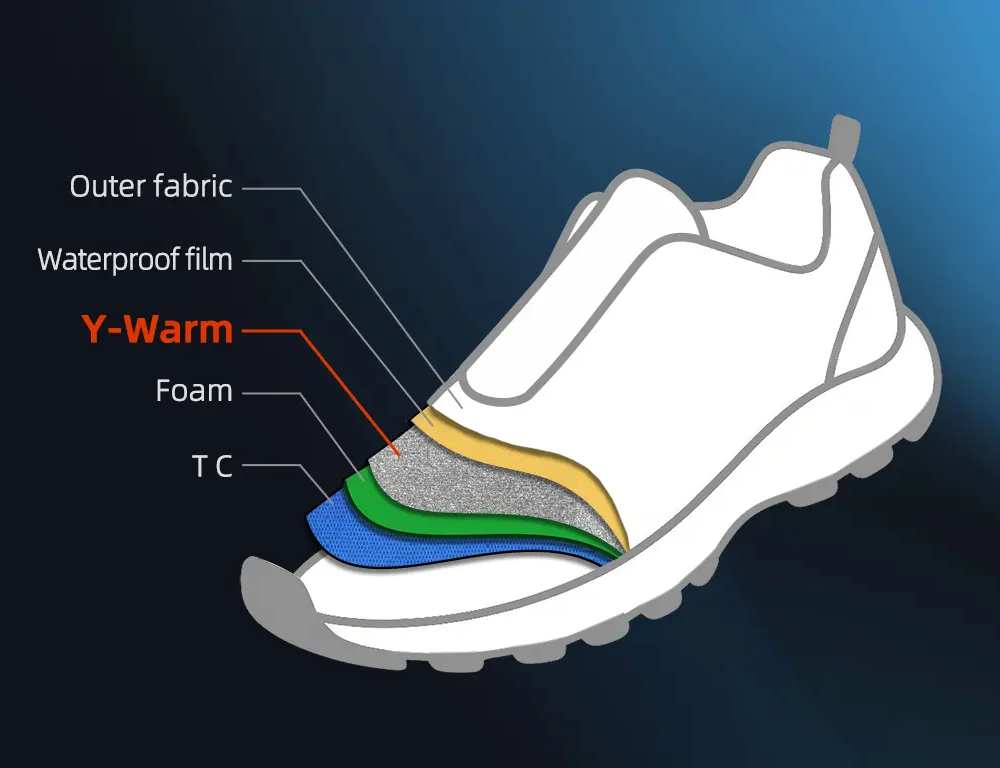
We designed Y-Warm specifically for demanding applications like footwear. Our material blocks thermal conduction at just fractions of a millimeter, providing consistent warmth without relying on loft that can be crushed. More importantly, Y-Warm adapts to multiple application schemes. Brands can choose: Fabric + Y-Warm + Lining for basic insulation; Fabric + Y-Warm + Fleece Fabric for added softness; Fabric + Y-Warm + Foam + Lining for extra cushioning; Fabric + Waterproof Membrane + Y-Warm + Lining for wet-condition protection; or Fabric + Waterproof Membrane + Y-Warm + Foam + Lining for maximum insulation and waterproofing. For lamination, we recommend PUR—an advanced, mature process that serves as the optimal solution for bonding Y-Warm with other shoe materials. Low-temperature hot-melt adhesive web lamination is an alternative, but it demands advanced skills and strict management; otherwise, Y-Warm's porous structure may be damaged.
Smarter Insulation for Smarter Footwear
Choosing the right shoe insulator means balancing warmth, compression resistance, moisture management, and manufacturing practicality. Y-Warm delivers on all fronts. Y-Warm is an innovative technology company specializing in metamaterial-based thermal insulation. Ready to upgrade your footwear collection with reliable, thin, and durable warmth? Partner with Y-Warm and help your customers walk warmly anywhere.